Lost Among Giants: What Easter Island’s Open Spaces Taught Me
Ever stood in a place so vast it made your breath catch? Easter Island isn’t just about moai—it’s about the silent spaces between them. I went searching for statues but found something deeper: wide skies, windswept plazas, and a sense of solitude that reshapes your soul. These public spaces aren’t empty—they’re full of meaning. Let me take you where the land speaks louder than crowds ever could.
Arrival: The First Glimpse of Rapa Nui’s Expansive Spirit
Landing at Mataveri International Airport on Rapa Nui—Easter Island—feels less like arriving at a tourist destination and more like stepping onto the edge of the world. The plane descends over a landscape that seems to stretch endlessly, bounded only by the Pacific’s blue horizon. There are no city skylines, no highways, no signs of dense development. Instead, rolling green hills, volcanic cones, and open fields greet the eye. The airport itself is modest, with a single runway that ends just short of the sea, as if the island barely holds on to the rest of the world. This first impression—of space, stillness, and isolation—is not incidental. It is the essence of Rapa Nui.
Most travelers arrive with images of moai carved into their imaginations—those towering stone figures with solemn faces, standing in silent rows. Yet what strikes you immediately is not the statues, but the emptiness around them. The island covers just 63 square miles, yet it feels immense. The roads are quiet, the towns small, and the distances between sites vast. Unlike many heritage destinations crowded with tour groups and commercial stalls, Rapa Nui moves at its own pace. There are no traffic jams, no neon signs, no souvenir megastores. The island refuses to rush you. Instead, it invites you to slow down, to notice the wind in the grass, the cry of seabirds, the way shadows stretch across the land in the late afternoon.
This spaciousness is not a lack of development, but a reflection of cultural values. The Rapa Nui people have long lived in harmony with their environment, shaping their settlements and sacred spaces to align with natural rhythms rather than impose on them. From the moment you step off the plane, you are entering a place where public space is defined not by walls or gates, but by openness and reverence. The island does not announce its significance with fanfare. It reveals itself gradually, in the quiet moments between destinations, in the empty fields where a single moai stands watch over the sea.
Beyond the Moai: Understanding Public Space in a Sacred Landscape
The moai are undeniably iconic, but to focus only on the statues is to miss the deeper story of Rapa Nui’s public life. These figures were never meant to be isolated artworks. They were placed on ahu—ceremonial platforms that functioned as the heart of community life. Each ahu served as a gathering place, a site for rituals, celebrations, and ancestral veneration. Positioned along the coastline or in open fields, they were accessible to all, designed to be seen and experienced collectively. The space around them was as important as the statues themselves—a shared domain where the living connected with the past.
What makes these spaces so powerful today is their continued sense of presence. Visitors do not swarm these sites in tightly packed groups. Instead, they move slowly, often alone or in small clusters, speaking in hushed tones. There are no ropes or barriers at most ahu, yet people instinctively respect the sanctity of the place. They sit on the grass, gaze at the horizon, or walk quietly around the platforms. This behavior is not enforced by rules, but shaped by the environment itself. The vastness of the sky, the sound of the waves, the weight of centuries—all of it encourages reflection rather than recreation.
Modern conservation efforts have preserved these sites without over-developing them. There are no ticket booths, no audio guides required, no timed entry systems. Informational signs are minimal and tasteful, offering context without overwhelming the experience. This restraint allows the landscape to speak for itself. The ahu are not museums; they are living parts of the island’s cultural memory. When you stand beside a restored platform, you are not just observing history—you are occupying the same ground where generations of Rapa Nui people once gathered, mourned, celebrated, and remembered.
Tongariki at Dawn: Where the Community Once Gathered, Now the World Watches
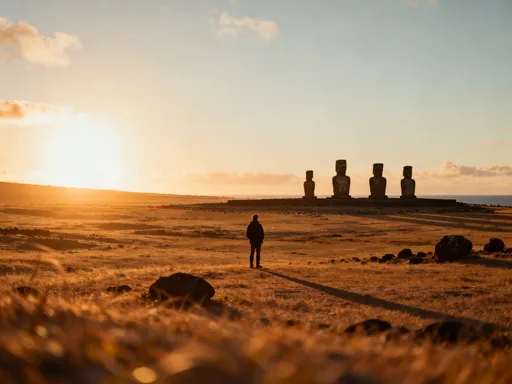
Ahu Tongariki is the largest ceremonial platform on the island, home to fifteen restored moai standing in solemn unison along the eastern coast. Once toppled and scattered by upheaval and time, the site was meticulously reconstructed in the 1990s, a testament to both archaeological dedication and cultural resilience. But what makes Tongariki extraordinary is not just the scale of the restoration, but the space that surrounds it. The platform sits at the edge of a broad, flat plain, backed by volcanic hills and fronted by an unbroken stretch of ocean. There are no fences, no viewing decks, no designated photo spots. Visitors are free to walk among the moai, to sit at their feet, to face the sunrise just as the ancient islanders once did.
Dawn is the most profound time to visit. Long before the sun rises, small groups begin to arrive, moving quietly across the field. Some bring blankets, others sit cross-legged on the lava rock. There is no chatter, no flash photography, no rush. As the sky shifts from indigo to gold, the moai emerge from shadow, their features softening in the light. In that moment, the space transforms. It is no longer a tourist site, but a place of shared witness. People from different countries, speaking different languages, are united in silence, watching the same sun rise over the same sea that greeted the Rapa Nui ancestors centuries ago.
What was once a center of spiritual and communal activity has become a global stage for quiet connection. Yet it retains its authenticity because the space itself resists commercialization. There are no vendors, no guided tours at sunrise, no attempts to monetize the moment. The experience is free, open, and unstructured—exactly as it should be. Tongariki teaches us that public spaces do not need entertainment or instruction to be meaningful. Sometimes, all they need is room to exist, and time to breathe.
Hanga Roa’s Heart: The Town Square as Living Culture
While the ahu are the spiritual anchors of Rapa Nui, the town of Hanga Roa is its living, breathing center. Home to most of the island’s 7,000 residents, Hanga Roa is a modest settlement with a single main road, family-run guesthouses, and a relaxed pace of life. At its core is the central plaza, a grassy open space surrounded by the church, the municipal building, and a few small shops. This is where islanders gather—not for shopping or sightseeing, but for life. On weekends, the plaza hosts cultural events: traditional dance performances, craft fairs, and community meals. Children play near the palm trees, elders sit on benches, and musicians tune their instruments under the open sky.
Unlike many tourist towns that relegate local culture to staged shows or ticketed events, Hanga Roa integrates tradition into daily public life. The plaza is not a performance space; it is a community room without walls. When the Rapa Nui people dance the tamure or chant ancient songs, they are not doing it for tourists—they are doing it for each other. Visitors are welcome to watch, but they are not the focus. This authenticity is rare in the modern travel world, where cultural experiences are often packaged and sold. Here, culture is not a product. It is a practice, sustained in shared space.
The weekly market is another example of this organic public life. Held in a covered pavilion near the waterfront, it features local artisans selling woven hats, carved wooden figures, and handmade jewelry. Prices are fair, interactions are personal, and bargaining is uncommon. There is no mass-produced merchandise, no plastic souvenirs from overseas. What you find here is made by hand, often by the person selling it. The market is not designed to impress outsiders; it exists to support families and preserve skills. In a world where tourism often erases local identity, Hanga Roa holds on to its own rhythm, proving that public spaces can thrive without sacrificing authenticity.
The Roads Less Traveled: Open Fields and Forgotten Pathways
Beyond the main roads and popular sites, Rapa Nui reveals another layer of public space—one defined not by monuments, but by movement. Ancient pathways, once used to transport moai from the quarry at Rano Raraku to coastal ahu, still crisscross the island. These trails are not paved or marked with signs, yet they are easy to follow, worn into the earth by centuries of foot traffic. Walking them, you feel a connection to the past not through interpretation panels, but through the simple act of stepping where others have stepped before.
The island’s interior is a network of open fields, lava rock walls, and grazing lands where sheep and horses wander freely. Amid these landscapes, you’ll find isolated moai, half-buried in grass, or ahu platforms with only a single statue standing. These sites are rarely crowded, sometimes not visited at all in a given day. Yet they are not abandoned. They are protected, respected, and accessible. You can sit beside a lone moai and have the entire horizon to yourself. There are no entry fees, no opening hours, no security guards. The freedom to explore is part of the island’s ethos.
This unstructured access encourages a different kind of travel—one based on discovery rather than checklist tourism. You don’t come to Rapa Nui to see ten sites in one day. You come to feel the land, to get lost in its quiet, to let the silence fill you. The open fields and forgotten pathways teach us that public spaces do not need to be designed or managed to be valuable. Sometimes, the most meaningful experiences happen when no one is watching, when there is no program, no agenda—just you, the wind, and the stones.
Design Without Walls: How Nature Shapes Public Experience
One of the most striking things about Rapa Nui is how little is built. There are no grand plazas enclosed by buildings, no fountains, no paved promenades. Instead, public space is shaped by nature: the curve of a bay, the slope of a volcano, the line of the coast. The three main volcanoes—Terevaka, Poike, and Rano Kau—anchor the island’s geography, their forms influencing where people gather, rest, or look out to sea. The wind, often strong and constant, determines where it’s comfortable to sit. The quality of light at different times of day draws visitors to certain viewpoints at dawn or dusk.
This natural design philosophy means that every public experience feels unique and unrepeatable. At Orongo, the ceremonial village perched on the rim of Rano Kau crater, the space is defined by stone walls and the vast caldera below. There are no benches, yet people naturally pause at the edge, drawn by the view of Motu Nui islets in the distance. At Anakena Beach, palm trees provide shade, and the white sand invites barefoot walking. No one has to tell you where to go or what to do. The environment guides you.
In contrast to modern urban planning, which often relies on furniture, signage, and controlled access, Rapa Nui demonstrates that nature itself can be the architect of public space. The island does not need to instruct its visitors. It simply offers itself—open, unguarded, and full of quiet intention. This approach fosters a deeper kind of engagement, one based on observation, intuition, and respect. When space is shaped by wind and water rather than concrete and steel, it invites a different kind of presence—one that is contemplative, not transactional.
Lessons from Rapa Nui: Reimagining Public Spaces Back Home
What can the rest of the world learn from Rapa Nui’s approach to public space? In an era of crowded cities, over-designed parks, and hyper-commercialized tourism, the island offers a powerful alternative. It shows us that space does not need to be filled to be meaningful. Silence is not emptiness—it is presence. And shared heritage does not require control; it requires trust.
Too many urban public spaces are designed for efficiency rather than emotion. They are paved, programmed, and policed, optimized for foot traffic but not for reflection. Benches face pathways, not horizons. Signs dictate behavior. Events are scheduled down to the minute. While these spaces serve practical purposes, they often fail to inspire. Rapa Nui reminds us that people crave openness, stillness, and the freedom to move without direction. A public space does not need to entertain us. It needs to hold us—to allow room for grief, joy, memory, and wonder.
For travelers, the lesson is to slow down, to seek out the quiet corners, to value what is unmarked and unadvertised. For city planners, it is to consider how nature, history, and silence can be integrated into design. A park does not need a stage to host culture. A plaza does not need a fountain to draw people. Sometimes, all it takes is space—unowned, unoccupied, and open to interpretation. Rapa Nui teaches us that the most powerful public spaces are not those that tell us what to do, but those that allow us to discover what we feel.
The Power of Empty Ground
Standing on the edge of the island at sunset, with the Pacific stretching to infinity and a single moai standing guard in the distance, you understand what Rapa Nui truly offers. It is not just a destination, but a state of mind. The greatness of this place lies not in the number of statues, but in the space between them—in the open fields, the quiet coastlines, the unclaimed ground where wind and memory meet.
These spaces do not belong to any one person or nation. They are shared not by law, but by respect. They invite not consumption, but contemplation. In a world that measures value by activity and output, Rapa Nui stands as a quiet rebuttal—a reminder that some of the most profound human experiences happen in stillness, in solitude, in the simple act of being present.
When you leave the island, you carry more than photos or souvenirs. You carry the feeling of space—the knowledge that silence can be full, that emptiness can be rich, that the ground beneath your feet can hold centuries of meaning. And perhaps, when you return home, you will look at your own public spaces differently. You will see not just benches and signs, but possibility. You will remember that sometimes, the most powerful thing a place can offer is simply room to breathe.